
Pull Out Testing for screws,Rebar & Anchors in Singapore
On-site load testing for post-installed anchors, chemical anchors, rebar, and mechanical fixings — fast turnaround, detailed reports, trusted by Singapore's construction and engineering sectors.

What Is Pull Out Testing?
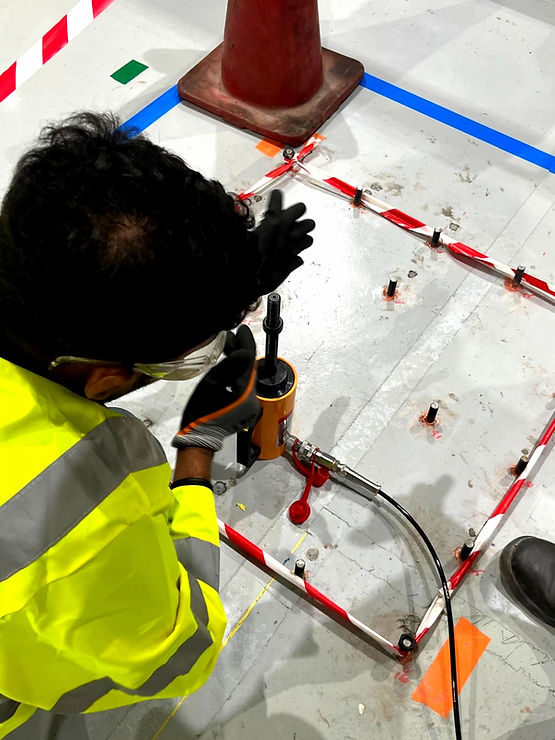
Pull out testing — also called anchor pull out testing or anchor load testing — is a method of verifying that a fixing or anchor installed into concrete, masonry, or other structural substrates can carry its intended load.
A calibrated hydraulic testing device applies a controlled tensile force directly to the anchor or rebar. The test measures the maximum load the fixing can sustain before failure — confirming whether it meets the design specification or identifying defective installations before they become structural problems.
Pull out testing is used for:
-
Post-installed chemical anchors — epoxy and polyester resin anchors installed into existing concrete
-
Post-installed mechanical anchors — expansion bolts, undercut anchors, and sleeve anchors
-
Rebar continuity anchors — rebar drilled and bonded into existing concrete for structural connection
-
Cast-in fixings — verification of cast-in bolts, channels, and sockets after concrete pour
-
Façade and cladding fixings — verification of fixings supporting external cladding panels
-
Rooftop and MEP fixings — anchors supporting rooftop equipment, pipework, and mechanical services

WHY IS PULL OUT TESTING IMPORTANT
Why Pull Out Testing Matters on Singapore Worksites
Singapore's construction environment presents specific challenges that make anchor verification essential — not optional.
Concrete quality variation.
Not all concrete on Singapore worksites achieves its specified strength uniformly. Pull out testing identifies weak zones and understrength concrete that would not be detected by visual inspection alone.
Post-installed anchor reliability.
The performance of a chemical or mechanical anchor depends heavily on the installation procedure — hole diameter, depth, cleanliness, and curing time. Even minor deviations reduce anchor capacity significantly. Pull out testing confirms actual performance, not assumed performance.
Rebar continuity connections.
When rebar is drilled and bonded into existing concrete to form a structural connection — for extensions, top-up slabs, or RC repairs — the bond strength must be verified. A failed rebar pull out test identifies inadequate hole preparation or insufficient resin fill before the structure is loaded.
Regulatory and consultant requirements.
Structural engineers, BCA-submitted projects, and government contracts in Singapore increasingly specify pull out testing as a mandatory quality assurance step — particularly for post-installed anchors and rebar dowels.
Liability protection.
For contractors and developers, a documented pull out test report provides a clear record that fixings were installed and verified to specification. This protects all parties in the event of a structural query or insurance claim.
.jpg)
WHAT WE TEST
Pull out testing — also called anchor pull out testing or anchor load testing — is a method of verifying that a fixing or anchor installed into concrete, masonry, or other structural substrates can carry its intended load.
A calibrated hydraulic testing device applies a controlled tensile force directly to the anchor or rebar. The test measures the maximum load the fixing can sustain before failure — confirming whether it meets the design specification or identifying defective installations before they become structural problems.
Pull out testing is used for:
-
Post-installed chemical anchors — epoxy and polyester resin anchors installed into existing concrete
-
Post-installed mechanical anchors — expansion bolts, undercut anchors, and sleeve anchors
-
Rebar continuity anchors — rebar drilled and bonded into existing concrete for structural connection
-
Cast-in fixings — verification of cast-in bolts, channels, and sockets after concrete pour
-
Façade and cladding fixings — verification of fixings supporting external cladding panels
-
Rooftop and MEP fixings — anchors supporting rooftop equipment, pipework, and mechanical services

What FRT Tests
🔩 Chemical Anchors Epoxy and polyester resin anchors — the most common post-installed anchor type in Singapore. We verify bond strength and confirm anchors meet design load requirements.
⚙️ Mechanical Anchors Expansion bolts, undercut anchors, wedge anchors, and sleeve anchors installed into concrete and masonry. Testing confirms expansion and load transfer are performing correctly.
🦾 Rebar Pull Out Testing Rebar drilled and bonded into existing concrete for structural continuity. Essential for RC extensions, top-up slabs, and repair works. Bond strength verification before loading.
🏗️ Cast-In Fixings Post-pour verification of cast-in bolts, anchor channels, and sockets. Confirms correct positioning and embedment depth were achieved during the pour.
🏢 Façade & Cladding Anchors Fixings supporting external cladding, curtain walls, and façade systems. Pull out testing gives engineers and building owners confidence in façade fixing integrity.
🔧 MEP & Rooftop Anchors Anchors supporting mechanical, electrical, and plumbing services, rooftop plant, and equipment. Verification before systems are commissioned and loaded.

How Our Pull Out Testing Works
Step 1 — Enquire & Scope
Contact FRT with your project details — the anchor type, substrate, design load, number of anchors to be tested, and your location in Singapore. We will provide a quotation and proposed testing schedule within 24 hours.
Step 2 — On-Site Testing
Our team attends your site with calibrated hydraulic pull out testing equipment. Tests are carried out directly on the installed anchors — no anchors need to be removed or sacrificed in standard proof load testing.
Step 3 — Results on the Spot
Each anchor is tested to the specified proof load (typically 1.5× or 2× the design load, as specified by your structural engineer). Pass/fail results are available immediately on site.
Step 4 — Test Report Issued
A detailed written test report is issued after each testing session. The report includes the anchor reference, applied load, maximum load achieved, pass/fail status, and equipment calibration details — suitable for submission to structural engineers, BCA, and project QA files.

WHO NEEDS PULL OUT TESTING
Who We Work With
Construction Contractors Verify post-installed anchors and rebar dowels before your RC works are covered up or loaded. Pull out test reports protect you in the event of a structural query and satisfy QA requirements on BCA-submitted projects. Fast scheduling means testing fits around your programme.
Structural Engineers & Consultants Specify pull out testing as part of your anchor design submission and we will carry it out to your exact load and quantity requirements. We provide test reports in a format suitable for your project QA file and BCA submission. We are experienced working alongside engineering teams on both new build and conservation building projects.
Government & Public Sector Projects LTA, HDB, NParks, and other government projects frequently require anchor testing as a condition of works. FRT provides documented, calibrated testing with full reports suitable for government project QA and submission requirements. We are experienced with the documentation standards expected on public sector projects in Singapore.
Building Owners & Facility Managers If you are retrofitting anchors for new MEP services, rooftop equipment, or façade systems on an existing building, pull out testing verifies that your existing concrete substrate can support the new loads — before the works are built and loaded.

Why Singapore's Construction Sector Chooses FRT
📋 Detailed Written Reports Every test produces a written report with full load data, equipment calibration details, and pass/fail status — suitable for QA files, structural engineer review, and project submissions.
⚡ Fast Turnaround Quotation within 24 hours. Testing scheduled to fit your construction programme. Report issued promptly after each testing session.
📍 Island-Wide Coverage We test across Singapore — from Jurong to Changi, including HDB estates, commercial developments, industrial facilities, and government projects.
🔬 Calibrated Equipment All pull out testing equipment is calibrated and maintained to ensure accurate, repeatable results you can rely on and submit with confidence.
💬 Direct Communication You deal directly with our team — not a call centre. Get straight answers on scheduling, scope, and reporting without delays.
🏗️ Experienced Across Project Types New build, A&A works, conservation buildings, government projects, and industrial facilities. We understand the documentation and scheduling requirements across different project types in Singapore.
Get a Quotation for Pull Out Testing
Have your project details ready and contact us through any of the options below. We respond to all enquiries within 24 hours on business days.
📱 WHATSAPP US Prefer a faster response? WhatsApp our team directly.
📞 CALL US +65 67433652 Monday to Friday, 8:30am – 5:30pm
